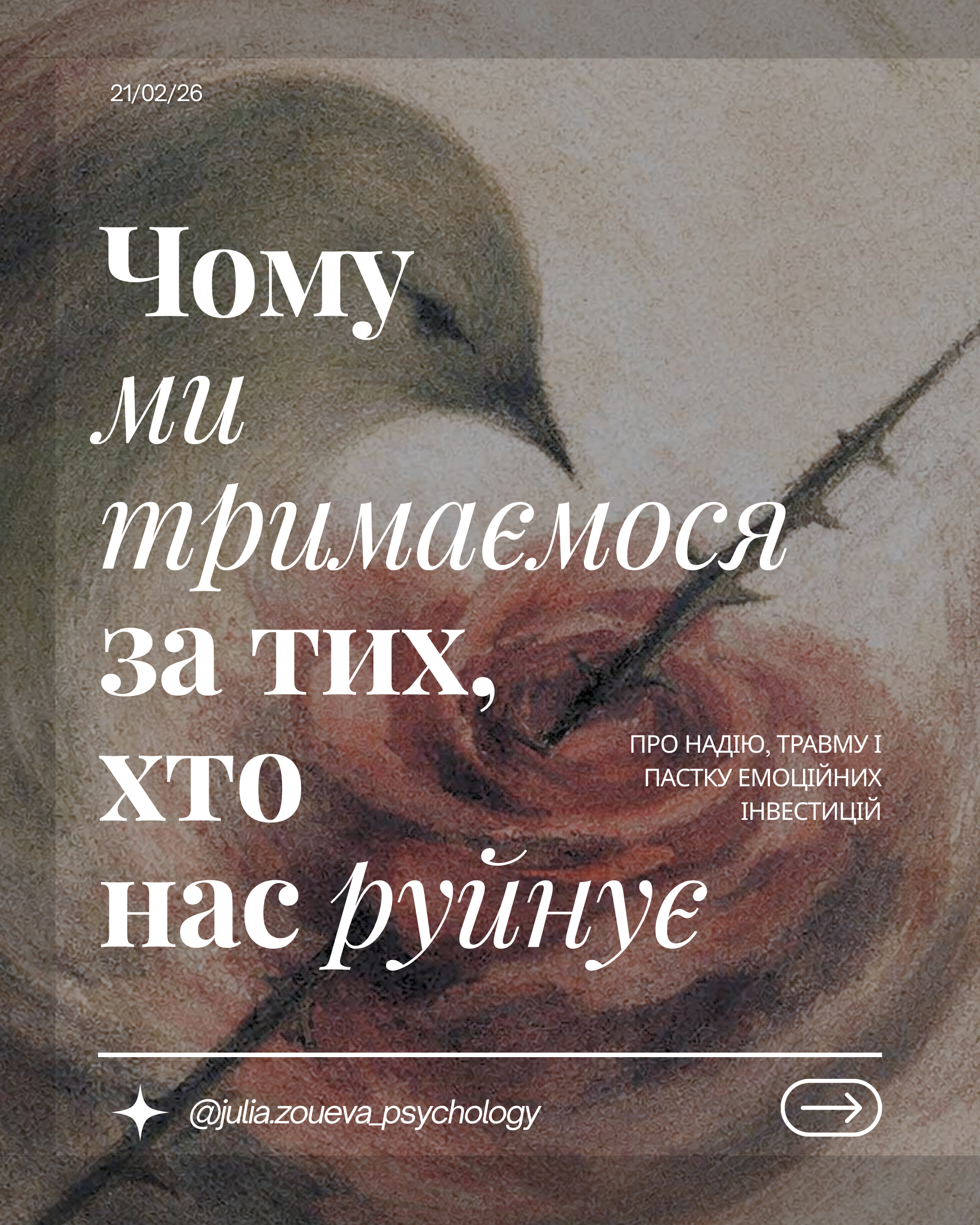
As a psychotherapist, I often witness how people devote their lives to the past.
There is a strange paradox of the human psyche: we often continue to believe in people precisely when real-world experience tells us otherwise. For many, this irrational belief becomes the foundation of life, but the price of such "devotion" is the gradual loss of one's own "I".
Hope as a survival strategy
For a child growing up in an atmosphere of emotional deprivation, conflict, or abuse, hope is more than just optimism. This is the only protection tool available.
When you're six years old, it's almost impossible to accept that your adult self (on whom your survival depends) is cold, unstable, or dangerous. This would mean being in a psychological vacuum where there is no security. Therefore, the child's psyche chooses magical thinking:
"If I'm good enough, Mom will smile."
"If I can learn to guess the footsteps behind the door, I can control the chaos."
In this sense, what we later call codependency is initially an act of incredible adaptability. This is a way to maintain the connection at any cost - because this connection is the fundamental condition without which the child cannot survive either physically or mentally.
The trap of emotional investment and compulsive repetition
The problem with adulthood is that this childish mechanism does not go away on its own. It turns into an internal screenwriter, forcing us to choose partners or friends with whom to play out the same waiting drama over and over again.
In psychoanalysis, this is called obsessive repetition: the psyche unconsciously seeks to return to the traumatic situation in order to try to "win" it this time. We choose cold or unstable partners in the hope that if we make them love us this time, the old childhood wound will finally heal. This is the illusion of control: we believe we can change the ending of the past through the present.
Another psychological mechanism is at work here, very similar to investment. The more time, emotion, care and effort we have already invested in a relationship, the harder it is for us to admit that it is not working. It hurts the psyche to accept that the investment will not bring the result we hoped for for so long. That is why we continue to invest more - more patience, more explanations, more hope.
Beyond the point where loyalty to another becomes betrayal of self, we often continue to invest in things that do not give life, only increasing the volume of our own inner desolation.
Aggression as resistance to mourning
When we refuse to mourn a lost illusion, it doesn't disappear—it transforms. Unprocessed mourning often turns into chronic aggression.
Instead of facing the sharp pain of helplessness, we begin to rage at the other. We demand, blame, try to "beat out" recognition or love. This rage is a desperate attempt by the psyche to force reality to obey our hope.
But while we are angry, we still remain in close contact with the object.
Aggression is also glue.
It keeps us close to those from whom it is long time to leave, giving us a illusory sense of control over a situation beyond our control.
The role of therapy: from illusion to freedom
The most difficult stage of psychotherapy is not the search for causes, but the mourning process. We have to go through mourning the love we never got and the ideal partner that only exists in our imaginations.
The therapist's job is to help the client face the truth: You may be perfect, but that won't make the other person love you if they can't.
This is the moment of the birth of the Adult - that part of us that is able to see reality without anesthesia, to admit that some people are dangerous for us, even if we love them.
It is also the ability to live with powerlessness — to allow yourself to feel sadness instead of anger. Sadness frees you from repeating scripts, while anger only binds you to them.
And finally, it is an opportunity to stop being "comfortable": to listen to your own needs, and not to guess the steps behind the door.
Maturity as a rejection of illusions
True freedom begins where waiting ends. When the inner adult takes the wheel from the child who is still standing by the door listening for the lock.
It is a painful way to let go of the hope for "revenge" in order to finally get yourself.
But it is at this limit that relationships begin, in which love no longer needs to be earned - because there is reciprocity, respect and security in them.